Saturday, February 25, 2012

On the Polar Bear, and the Plunge

Happy Lent! Or, as our brothers and sisters in the East would call it, happy Great Lent! Content with being a Westerner myself, there is nevertheless something about the exuberance and one-up-manship of the East that continuously snags at my heart.

It's not possible for me to look at the Bridegroom without longing, that pre-eminent language of the heart.
In this same spirit of exuberance, five friends and I rose early last Ash Wednesday, met at the church, drove the 20 minutes down to Lake Erie, and took ourselves a plunge in the pre-dawn, sub-40 degree swill (for all you non-Clevelanders: over at a great little concert club called the Beachland Ballroom, the water jug in the bar is marked "Lake Erie Cocktail." This is a joke because no one in their right mind would ever drink anything that came out of that huge hole in the ground). Why did we do this? Good question: we really only hit the water for less than a minute, spent a few minutes congratulating ourselves, then went our separate ways, I to the job, hair still slick with the brine. So what was the point?
Certainly I asked myself the same thing as I picked the sand  from between my toes a bit later. The reasons one of my friends had given me the night before in our feverish "should we or shouldn't we?" debate were: 1) act of penitence to kick off the Lenten season and 2) act of community (shared suffering nearly always has an odd community-building effect). These two reasons were appropriately Lenten, but I think there's a third one, which is perhaps only secretly Lenten, but nevertheless reveals the heart of the season, and that is that same exuberance and one-up-manship we find in the East.
There is something so spiritually enlivening about moving to the excessive. Why? Because it is in response to Christ, who has first been excessive in his love, prodigal even, pouring it out upon us, who so often allow it to be wasted. But if Christ is excessive, exuberant in this outpouring, then this is love. That is, God, who is love, shows us what love is by showing us himself, in Christ and in the movement of the Spirit throughout history, drawing us to Him.
So love is excessive, exuberant, constantly longing to go beyond, to be larger, to give oneself more. That is the secret at the heart of Lent: not that we are terrible and sinful and unworthy, but that even in our terrible, sinful unworthiness, Christ goes beyond. This season is emphatically and above all not about us. It is in fact about something much greater than us: it is about us and Christ, but even more centrally, it is about Christ, who through the Holy Spirit beckons us to communion with the Father.
What does this mean? It means that this season of longing, of seeking the Bridegroom, is not about punishing ourselves, as if such a thing could be pleasing to the One who loves us (think about it: say you are a parent and one day one of your children comes to you and says, "I love you so much that I am going to punch myself in the face every day just to prove it." Your response would rightly be a rather high level of alarm).


No - fasting is not about punishment, but about longing. We give up what is right and good (e.g., being warm and dry on a Wednesday morning in February) in order to remember that there is something even more important than us. Life is not just the avoidance of pain. In fact, life often necessitates pain - ask any mother about giving birth. A woman does not give birth in order to punish herself, but to go beyond, in the excessiveness of love, to open her heart to a new person, a new life. A father does not give himself to his wife and his children in order to punish himself, but in order to continuously break his heart further open in the prodigality of love.
That is what this season is about - to shatter the attachments of our hearts like the glass that they are, to allow the Holy Spirit to breathe a heart of flesh into our chests, and to allow that heart to beat in unison, in union, with the very heart of Christ.
So why a polar bear plunge into the nigh-on toxic waters of Erie? It was an excess, an exuberance, a going-beyond what is expected, to give even more than what is demanded. It was only an action, yes, but so is an embrace, a hand on the shoulder of a suffering friend, or the uttering of those three words. It was a longing to be engaged in the great romance for our souls that God is even now pursuing. May our Lents be the same - full of fasting, full of longing, full of actions of excess, of overflowing love, and of knowing ourselves, even here in the desert, to be pursued, down the nights and down the days, by the scenting of the Hound.


Tuesday, February 21, 2012

On Drudgery and the Desk

Being newly-inserted into the great American deskforce, I've come to know a bit more about myself in these last months. How my speech begins to slur after about 6 hours of slumping in front of a computer screen (NB: if you call between 2:30 and 4:30, I will likely be surly and difficult to understand. This doesn't mean I'm a bad person. Honest). How my eyes start losing the ability to focus on anything further than a foot and a half away after 6 and a half hours. How I feel several inches shorter when I leave than when I came (literally - the other day I got in my car after work and couldn't see out of my rear view mirror because of how slouched and beaten I was).

This product is rather intriguing. Or at least it would be on those days I can't decide whether I want to nap or just be softly suffocated.

At any rate, I'm sure you're thinking "But Sir! (or madam?) What has all this to do with Christ?" I'm getting to it (I hope). In the muddle of the day to day, I have to do any number of things that I would prefer to leave for the birds, perhaps the foremost of which is answering the !#@&$  phone.

I wish I was this cool, but our phones have buttons on them.

It rings and rings, never when you expect it, always when you're just about to actually get some actual work done. I have piles of paper on my desk that still need to be sifted, an inbox that I haven't touched in months, and a good backlog of things I need to do but have probably already forgotten about (how do I keep my job? Looks alone, apparently). I keep catching myself thinking, "If someone else would just answer the freaking phone, I might be able to do my job."
Then I thought, "Wait a second. Answering the phone is my job." The phone isn't what interrupts me when I'm doing my job, it is my job. It is the reason I was hired. And here comes Jesus: Isn't that a lot like the spiritual life? We separate things out, and the religious part of our lives is only that which is encompassed by church on Sundays, or maybe an occasional awareness of God's presence. The rest of the time we kind of float through, without any feelings either way (or maybe even feelings of sadness, abandonment, and anger). We think, "If only I could feel God's presence all the time and quit with this other stuff which is unimportant and distracting, then I would be holier/better/perfecter/awesomer/the bester/etc." But we forget that those moments of mundaneity are life. That is, these moments of boredom, disconnection, etc. are not merely moments to be gotten past and forgotten.
This is admittedly a weak metaphor. But the point remains the same - life is not made up of those moments you move past and the occasional moment of transcendence, where all importance lies in those brief moments and the rest are to be forgotten. Life is life - it is all wonder, even those times when we sit at the desk and slowly allow our backs to reform into a greater 'S' shape. This is the insight I still hope to one day be able to embody - to shout out with Bernanos' priest that "All is grace!"

Why can he say this? Because his eyes are on Christ.
It's not an easy thought - this "practice of the presence of God" in every moment, even those moments that seem the most worthless, the most easily ignored, the easiest to throw away (e.g., I still struggle to see how the hours between 8 and 4:30, roughly, 5 days a week have anything to do with my spiritual life. But unless I am to fall into the great American secularist pigeon-holing mindset, they must).
It strikes me that there is a definite similarity here between this description of time, and a description of the poor, which may provide the key to a way out. The poor are often seen as the most worthless, the most easily ignored, and the easiest to throw away. This applies whether they be the homeless, the socially awkward, the unborn, or even the people calling in to ask for information. It is often a struggle to see how these people relate to our spiritual lives, but if we are to be saved - since no one is saved alone, but only within the complex mesh of relationships in which we are already embedded - if we are to be saved, these people must be related to our lives, spiritual and otherwise.

Aside: On the topic of no one being saved alone, Dorothy Day had a great line in one of her articles, in which she quoted a French theologian as saying "If, when you die, you come to Heaven alone, God will look at you and say, 'Where are the others?'" 
Dorothy Day, biotches!
So perhaps here is the clue: if we begin to understand that all is infused with wonder, that is, with the very presence of Christ, through the power of the Holy Spirit, we can begin to open ourselves to His movement in our hearts, even in the most mundane of moments. In this we can take a cue from one of our most recent saints, Andre Bessette, who was a simple doorman at a monastery in Montreal, but who treated every person who came to the door as if they were Christ himself.


And if I were a far holier man, I would answer the phone in the same way. Because in a way, it is Christ who calls me on the phone, looking not for information, but for love, and for my love in particular.

Sunday, February 12, 2012

On Iconography

Living as I do in an area of Cleveland where the churches are locked, I've had to find other places to pray. I've set up a designated corner in one of my rooms for prayer, and, being deprived of the Eucharist, I've gone for the next best thing: icons. I'd like to say just a few words about icons both because I've found them to be very helpful and because I think we've lost an appropriate appreciation for them, especially in the West.

This is the one that I pray with daily.

The question that ought to immediately come up, especially to our pragmatic, deeply dualistic American minds is: why icons? Why use something (that is, some thing) in prayer? Shouldn't we just close our eyes, calm our thoughts, forget the world, and sit in the darkness? The answer to this is both simple and complex - we use things in prayer because we are things.
Let me be clear: I am not arguing that we are merely things - that idea fails to uphold the dignity of the human being. If a person were merely a body, the old adage "Love people, use things" could easily be reversed without any reprehensible consequences. In this case, personhood could be measured based on utility, just as the worth of a car or a machine is measured based on what it can do and how efficiently.
On the other hand, the belief that we're merely spiritual (or any of its contemporary manifestations - e.g., that I am my mind, situated in this globulous but ultimately accidental and incidental mass of cells; more classically - my soul is my true person, trapped within this prison which is my body) likewise fails to uphold our dignity. Why? Because we are our bodies (or, as Thomas Aquinas put it, anima mea non est ego - "My soul is not 'I'"). Without my body, there would be no me. I learn through my body, I explore the world with my body, I am open to contact with other people through my body. If this were not true, none of our displays of affection would have any meaning - a kiss is not merely a pressing together of slightly squishy meat parts, but an expression of personhood.


So why icons? Simple: we respond to our world through contact with it. By seeing it. By feeling it.
Initially, when I started praying with icons, even this argument held no weight for me. It wasn't enough to merely know myself as human, I wanted to jump to the divine and leave my body behind (in truth, this amounts to leaving my self behind, which, being a man still under the effects of sin and fallenness, I am not ready for yet). So in the beginning I didn't understand icons - I still don't, in the sense of an intellectual understanding that has seen all facets and knows them intimately. BUT I knew that the Church has had a long, long, looooonng tradition of praying with icons, so I trusted the Church, even against my own rational inclinations. In this sense, icons also teach us humility. Why? Because it is something that is not "I," it is something that confronts us with something other than ourselves (art participates in this dynamic as well, to a degree). In trusting the Church's tradition, we submit ourselves to her who acts as our mother in faith.
A secondary point - intellectual understanding is not the same as understanding. The intellect is powerful and beautiful and wants to order all things, turn them over, analyze them, and, in that way, exercise dominion over them. The problem with this is that, powerful and beautiful as it is, the intellect is not nearly powerful enough to apprehend the depths of the cosmos, the fascinating and intricate connections between all things, nor the depths of the human heart. The intellect, for all its goodness, often falls to the temptation of killing wonderment. If all questions are answered, then what use is curiosity?  What is worth our attention? By attempting to grasp everything with the intellect, we lose sight of the deeply mysterious quality of life, the universe, and everything. It is impossible to "know" a person in the sense of having examined all their facets. In fact, to know a person "intimately" is to know them as mystery.
This, on a different level, is what happens in praying with icons - they are mysterious, just as persons are mysterious, just as God is mysterious - not because they haven't been "solved" yet like "Unsolved Mysteries," but because they address the whole person, head and heart.

Robert Stack my be cool, but I doubt he'll lead you to fulfillment.
As Blaise Pascal wrote, "The heart has its reasons that reason doesn't know." So why icons? Because with Job, I know that my vindicator lives, and from my flesh I will see him (Job 19:25-26), even if that means that, with Job, my skin will have been stripped off (Job 19:26) - the skin of my pride, my trust in my own power, my reliance on intellect without heart. For this I long - to be stripped of that skin, and to behold Christ, my Lover, from my flesh.


Friday, February 3, 2012

On Sacramentality, the Sacred, and the Profane

Last summer, a couple seminarian friends and I had an in-depth conversation with one of  my cousins and a friend of hers, both of whom come from a non-denominational, fundamentalist background. In the course of this discussion, it became more and more clear to me that what was truly missing from their understanding was the sense of sacramentality which suffuses the Catholic mind. It was fascinating and deeply instructive to realize that we are not separated by simply ideological disagreement, but a different way in which our minds approach the world. For whatever reason (and they many), my cousin and her friend could not see material reality as being related to the divine on a deeply fundamental level. From what I understood of their position, they conceived of their relationship with God on a strictly personal, interior level, without any mediation necessary or even possible. This is probably a gross over-simplification, but it struck me what an impoverished worldview this was.
For instance, how would a person under this mindset understand encounters with the divine in human history? How could they appreciate that swelling of the heart that comes with a sunset? Or the works of Michelangelo? How could they hold onto the idea of a loving God and the reality of suffering in the same breath? How could they offer their own bodies in imitation of Christ, who bled his blood for us, and by whose stripes we are healed?


After all, God did not save us by simply inspiring us to live better lives and thereby to be justified, but by becoming incarnate in Jesus Christ. That is, God became physical and justifies us by the act of the Son's entire life, all of which was the living of self-gift, even in his body.
Being Catholic, no doubt I'm missing part of their argument. Perhaps they would point to Hebrews, which states that Jesus is our High Priest and sole mediator, which I would not argue with. But we too participate in this by being conformed to Christ. How can a husband and wife love each other if not through their bodies? How does a father or mother show love to the infant, the toddler, if not by holding them, carrying them, kissing them?


Looking at a picture like this, we have a very real inclination to do exactly that: to hold the infant and look her in the eyes. Why? Because she truly is beautiful, and the beautiful draws us, touches our hearts, and directs us, even forms our actions. Without an appreciation for the divine inbreaking, how can we acknowledge beauty as anything other than being "in the eye of the beholder"? A matter of opinion? But don't we reject that instinctively? Wouldn't we immediately think that something was wrong with the person who could find nothing to appreciate in an image like this?


But all of that I may return to in a later blog. For now, my point is that we face a grave temptation to separate, to compartmentalize. In other words, we may say, "this part of my life is sacred, allows me to connect with God, and this part does not." That is, in the general conception, we might say, my heart and my mind relate to God, but my body does not. This leads to fascinating consequences, wherein we separate what is "holy" and what is "not."
Church, for instance, is holy. Work, however, is not. Work is simply what we do during the day in order to make money, pay bills, etc. Unfortunately, this lends itself rather quickly to the idea that we are merely cogs in a machine. Religion, too, even if we claim it is of utmost importance, is simply relegated to the weekend, "that day we don't work." The problem with this conception is that 90% of our lives soon seem to be not related to God at all. This gives rise to a false notion of the separation of the sacred from the profane. But it's no mistake that some of the greatest works of art our race has produced are religious works. Consider this:


or even this:


And it's certainly no mistake that Gaudi, the visionary Spanish architect, brought so much of the world into his still-unfinished masterwork, the Sagrada Familia Basilica in Barcelona:

These are trees, supporting the roof
In the sculptures throughout that basilica, all of salvation history is played out among the trees and plants. Why? Because salvation history occurs precisely in history - in general history, yes, but also in each individual's history, in the course of a life lived down on the ground, among the trees and the plants, the animals, and most of all, each other.
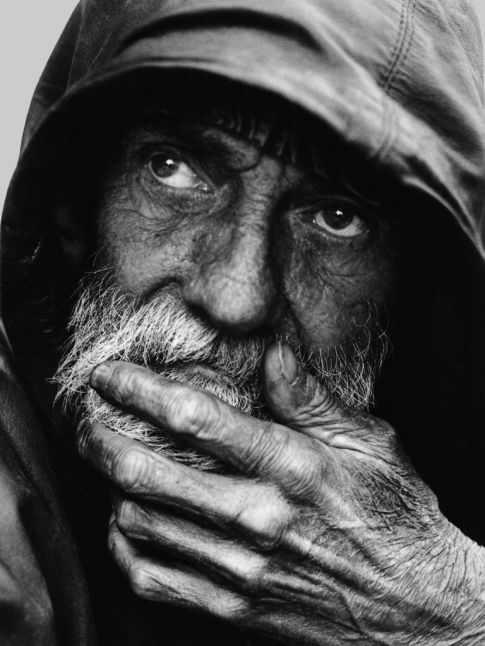
The real point here is that there is nothing, nothing in this life which is beyond the touch, the caress of God. There is no separation between the sacred and the profane. Certainly there is a separation between the sinful and the grace-filled, between love and fear, but there is no part of our lives or our world which does not relate to God. There is no part of our hearts that God does not long to inhabit, no part of our minds that He does not burn with desire for, the desire of a lover who waits. This false separation between the sacred and the profane came in with the loss of the sacramental mind, which is able to look at bread and wine and see Christ, to look at the marriage union and see Christ, to look at a simple pouring of water and see Christ. This is what allows us to look into the eyes of the poor and see not a nuisance or worthlessness, but Christ longing to be loved:


When the Church teaches that we are saved by the grace imparted through sacraments, she doesn't just mean that in a quantifiable sense (i.e., we need to receive so much grace through receiving the sacraments so many times in order to fill up our grace-bank). She also means that our hearts and our minds are formed by this very practice, formed in such a way as to allow us to participate in Christ's own life of self-gift, through our very bodies. Even when that body is sat down at a desk for 8 hours a day. Or spends dawn til dusk caring for children. Or lies in a hospital bed, dying. Nothing is beyond God's touch, and there is no part of the day when we cannot, with Paul, pray unceasingly.

Friday, January 27, 2012

On Being an Inkler, and the Dark

Way back in the sands of time (the 1930's-the late 40's, to be a bit more exact), an informal group of writers met weekly, either at the Eagle and Child pub in Oxford or in the rooms of C.S. Lewis, to read aloud unfinished works for mutual entertainment and criticism. The more prominent members of this group were Lewis (obviously), J.R.R. Tolkien, Owen Barfield, and Charles Williams, though any number of other people filtered in and out over the nearly 20 years the group met. This group called themselves the Inklings, and, while they were known for their good-humor, they also undertook a very serious task, which was to discuss the culture and form an appropriate response to it. This can be said to a greater or lesser extent of each of the members, but it is telling that at least three of them (Lewis, Tolkien, and Williams) came up with similar responses, born from their discussions and laughter over their weekly pint and pipe (notice the giant pitcher of beer next him at the end too).


In all three of these authors, we see the rejection of the desperate disconnection of the modern mindset, through the use of mythic or supernatural stories, in which the transcendent had a place. To be an Inkling was to seek an answer to the purported solitude of man in the cosmos, to seek to rehabilitate in the modern mind an openness to a world beyond the immediate senses, beyond the ken of science, which really functions as control. Simply put, it was to seek to restore the eyes to see.

The name "Inklings" was chosen for its double meaning. On the one hand, it can be seen as a tongue-in-cheek pun; these authors are spilling ink, producing little "inklings." On the other hand, it has the connotation of the beginnings of a thought, or of just beginning to apprehend something, or a vague idea about something.  This is the humility of the person standing before the immensity of life, just beginning to have an inkling of the presence of God, infusing it all with wonder. Even among those of us who see the connections (as the Inklings hoped to restore to us), it is still only an inkling of the intimacy of what's to come. To be an Inkling then means also being humble in the task of opening eyes: it is not done to shock or accuse, but to point at the heart-filling shape of the shoulder of God that looms.

But "inkling" in this second sense also carries a negative aspect: if we're only barely beginning to have an apprehension of something, that means that there is much, much more of it still veiled in shadow.
Think of it like this:


And this is the Dark, which is where I so often find myself in the spiritual life. I have no doubt about the immensity of the Father's love, just as I have no doubt about the rest of the moon, but I only see so little of it. The Dark can be a lonely place, but it can also be comfortable, like a child in the womb. Tolkien once wrote, "Not for me the Hound of Heaven, but the silent, never-ceasing appeal of Tabernacle, and the sense of starving hunger" (Letters, p. 340), and I think this is a very common experience, even among the most faithful of us (as Tolkien certainly was). What's interesting to note is that even for Thompson, the Hound was only really seen in retrospect, after years of struggle and suffering. But for most of us, I think Tolkien is nearer the mark. To paraphrase him, I have never known the pursuit of the Hound, but I have sat with Christ in the Dark and starved, and yet known this to be Christ's appeal of love to my own heart. And this is perhaps the most important directive for the spiritual life: do not give up. Do not interpret the Dark and the silence as abandonment, absence, or disinterest. See in it the inkling, the briefest fingertip of God reached to brush so lightly against your heart, and rejoice.

Wednesday, January 18, 2012

On the Theological Perfection of Being a Clevelander

The other day, as I was driving with a friend in the midst of a Cleveland slushfest, she expressed the opinion that snow is a direct result of the Fall. As I sit at my desk now, watching the snow float lazily down outside, I can't help thinking it's a bit more complicated than all that. While the snow certainly means that we can't gallivant about  naked as we came (at least not if we hope to survive for long), it does teach us certain things. For one, you can't drive like an idiot (though that doesn't seem to stop people from doing so). Second, there is a power out there that dictates some of our choices, even down to very small things (do I wear flip flops or boots? Do I have to take a shower today or can I hide my gross bedhair under a hat?). So it's true: maybe snow wasn't present in the Garden, but it does confront us with our limitations, and reminds us of our mortality. And this side of Eden, those are very good things.
But Cleveland is more than simply snowy. It's also a rusted-out reminder of former glory (back in the 20's, Cleveland was the fifth largest city in America. Now it's almost an afterthought to include it on a map). Not only that, but, to state the obvious, our sports teams suck. The closest we've come to glory in recent history was King James, who was unfairly expected to carry an entire team almost by himself (I can't count the number of times that he scored between a third and half or more of the points in a game. Mostly because I haven't taken arithmetic since grade school and I'm too lazy to actually look up the stats, but I'm sure it's impressive anyway). Regardless of that, when he left for warmer climes, he left most folks around here with a bad taste in their mouths (funny story: when James left, the stories-high banner of him by the arena was replaced with a picture of the Cleveland skyline. So in place of a poster child, we now have a picture of what we're already looking at). Beyond this, the economic downturn has left thousands of homes empty and huge, unused & crumbling warehouses scattered across the region. Add to this the fact that our 'theme song,' "Cleveland Rocks!" is so annoying that it would be difficult to find a more potent psychological disruption tool than forcing someone to listen to it on loop. Such an action would undoubtedly call down heavy recriminations, as well as the wrath of God.
What we've determined thus far: Cleveland is the embarrassing balding cousin that other cities don't like to mention, but wrinkle their noses at the thought of. So where's the good news? Cleveland is like the snow: it reminds us of our mortality, it teaches us humility, and it takes a certain kind of courage to love. Because Cleveland is loved, which is perhaps the most surprising of all. There's something deeply chest-warming about the underdog, even when that underdog is a city that hasn't won any titles other than "#1 Poorest City in the Nation" in decades. Why is that? Maybe it's because we all know ourselves to be the underdog, at some point in our lives. Maybe, even if not consciously, we identify with the broken because we know ourselves to be broken. And maybe, despite it all, we love Cleveland because it is beautiful.
Consider the snow again. Snow is inherently beautiful, from the freshly-fallen fields down to the uniqueness of the flake. It's a beauty that carries a lot of consequences (and doesn't beauty always?), but it is undeniably beautiful. So it is with Sunny Clevelandtown, where the sun nearly never shines. The city is beautiful. You look into the smashed-out-window eyes of the homeless, and, if you're looking, you're looking at Christ. That is where the city's greatness lies: it shows us a face of the suffering Christ. And not just the suffering Christ, but the joy-filled and loving Christ as well. The laughter of Christ resounds in these churches, houses, and streets. Not in any over-spiritualized or abstract way, but by teaching us about ourselves. By recognizing both the depression and the beauty, the rusted-out and the beating heart, and yes, the slush & ice and the sparkling fields, we hold two things in tension. On the one hand is death and decay and isolation; on the other, life and beauty and connection. Both hands are part of our lives. Think of a Browns fan: both great disappointment and hope, even when it makes no sense whatsoever, coexist.
And isn't that the common experience of every Christian? Of gradually coming to recognize our many faults and failings, and even more gradually coming to live that hope that dares to hope that "all men be saved?" We are not true if we cannot recognize our faults, yet we are even less true if we cannot accept being loved even in the midst of those faults. That is why I love Cleveland. It is a blighted city, a remnant of the long-departed steel industry, but it is full of hope, even hope without much real grounding. Think of the snow again: it is not always desirable, but it is beautiful. We are in the midst of it, and all we have is grace, even when that grace functions only to remind us of our limitations.

Tuesday, January 10, 2012

The Blog Itself

This blog is a new thing for me and will probably take a bit of getting used to (meaning that I don't really have a clear idea of what form it will take, but I hope that it may evolve somewhat organically). First, its purpose: I am in the throes of writing my master's thesis for an M.A. in Theology, and I hope to use this platform to explore some of the ideas I hope to work with. The thesis itself is much like this blog: unclear and growing (mushrooming, even) almost by itself. I am interested in looking at how Beauty can be used as a tool for evangelization (though words such as 'used' and 'tool' may already be wrong when applied to Beauty). To this end, I have read and am reading much (eventually I'll get around to putting up an exhaustive bibliography). Having been an English major in college, I'll be looking particularly at the effective (as well as affective) power of Beauty in literature (though undoubtedly the same exploration might be pursued in the realm of the visual arts or even of music).
In a nutshell: at the risk of sounding absurdly self-important (the undeniable bane of any blogger, but undoubtedly most of all of him who tries to "share ideas"), I took a brief glance back across the twentieth century and noticed a couple of movements: a rise in active-contemplative orders/ spirituality (Bl. Mother Teresa, Dorothy Day, Bl. Charles de Foucauld, to name a small few) as well as, especially in the 50's and 60's, a rise in major Catholic writers, producing important literature. Here one may name Francois Mauriac; Georges Bernanos; Shusaku Endo; Graham Greene (to an extent); J.R.R. Tolkien; and, in our own country, Flannery O'Connor and Walker Percy, among many others. Having noticed these two movements, I asked myself rather audaciously what the Holy Spirit had been trying to communicate through them. This I answered with a further question: how does one restore the contemplative mind and heart to modern man, trapped as he is in this hyper-individualistic, excessively scientific, post-modern, post-Christian, even in some sense post-spiritual context we call life? The way to do this, the only way to give man back his heart of flesh and his mind of wonder and awe, is to allow him to be increasingly confronted by Christ. This is done through prayer and work (active contemplatives) and through allowing our hearts to be pierced by Truth, Goodness, and Beauty. The last of these is perhaps the most excorciated of the three, at least in our present time, but it is undeniable that where one is denigrated, all three suffer. For this reason, the M.A. will focus on Beauty.
As for The Blog Itself - many things will be posted here; quotes I find interesting, musings about art, and perhaps once in awhile some poetry or a short story. I hope to post at least once a week as I read and (eventually) begin writing. It is for no less than the salvation of our souls that I hope to write this, not so that I may save our souls through whatever paltry work I may do, but it is my sincerest hope that the Holy Spirit will use this research, this thesis, and even this blog as a locus of the in-breaking of the presence and life of God, who longs to be held in our hearts, as he once was held in the arms of both Mary and Joseph.
Feel free to respond, share ideas, and comment on my windbaggery - Art is always and above all participatory and community-building. Pray for me as I for thee.