Wednesday, March 14, 2012

Placeholder

So I've been kicking around an idea for a post for a couple of weeks now but I haven't really had time to sit down and bang it out (whaaaaaat? Things are busy at work?!). It should be one of the more important ones I've written so far so I want to get it right. Way back in the beginning of the blog, though, I did promise some poetry or short stories as I saw fit, so this week I'll be sharing a poem I wrote on Ash Wednesday. Hope you like!


The Tomb, the Beast, the Sea (On the Occasion of Ash Wednesday, 2012)

The priest hunched, with ash-blacked thumb,
Comfortable and sheepish in his jeans and
Tennis shoes, murmuring,
Hands hovering over the gifts.

What am I? The ash that clung
To the corpse of Lazarus come forth,
Or the heart that beat blood anew, coursing that
Thumb with life?

Am I Peter, shirtless, with garment tucked,
in the midst of the leap,

Or am I Jonah, foot-splayed on the roiling deck?
Weeping -
at my foolishness,
weeping -
at the Love in which I am caught,
the Love that reaches me out
in the great gape of the beast,

that reaches me out
in the salt spray of the deep.

No, I am Peter, foot-deep in the swell,
Eyes on Him.

But for how long?

How long til I slip
And He reach his hand for me,
To grasp me in the crook of his staff,

In that goodness and kindness
which hound me relentlessly?

The priest straightened,
And with the ash, the thumb, the wheat,
I am raised,

Caught up in the tomb, the beast, the sea,
Caught up in Him
Who catches, catches,

And catches.

Ah, but is this not Lent?

Wednesday, March 7, 2012

On Desolation, Hope, and Mumford and Sons' "Feel the Tide"

As those who know me know, I love Mumford. I love their lyrics, I love their sound, I wish I could play banjo like they do.

Look at how freakin' cool these guys are. I would never wash my hair again and wear vests every day if it got me to be this cool.
I recently came across a b-side of theirs called "Feel the Tide," which is included on the deluxe version of their fantastic "Sigh No More." I'll give you the lyrics (from songmeanings.net, so any errors are the fault of that site, ha!), then my interpretation of it (and it's a doozy!):

Feel the Tide
She sits him down in a stiff chair
Rubs his back and strokes his hair
Telling him it's okay to cry
But he just sits and stares
The merciless moon outside
Has nothing now he's come to realise
Only the desolation he feels
The cold distance inside

But you and I now
We can be alright
Just hold on to what we know is true
You and I now
Though it's cold inside
Feel the tide turning

While the priest just sits and weeps
Lamenting the fact that he can see
Darkness and light in so much detail
He has given himself over
Refusing what he knows to be real
He turns away from every meal
Starving himself of goodness
He doesn't think he can heal

But you and I now
We can be alright
Just hold on to what we know is true
You and I now
Though it's cold inside
Feel the tide turning

"What if I lost all I had?"
Said the stranger to his dad
And the witness was confused
He can't tell what is bad
Instead he runs up to the nearest girl
And he comments on her glorious curls
Says, "Darling come with me
I'll show you a whole new world"

But you and I now
We can be alright
Just hold on to what we know is true
You and I now
Though it's cold inside
Feel the tide turning

So there it is, and here's what I understand of it (yes, I was an English major way back when):

The speaker is the same throughout the song - he's pointing at various examples of loss of hope, but with hope still beating, however frail.
First verse: the man is in desolation and can't even connect with his emotions anymore (she tells him it's okay to cry, but he just sits and stares). Even the moon has lost its meaning - in desolation, we believe that nothing is meaningful and never can be again. BUT the important part is that the woman is consoling him. Here there is hope. The relationship has not been severed, and she will stroke his back and hope for him.


Aww, cheer up, Johnny!
Chorus: hope lives even when it cannot be seen or felt. We feel cold inside, but hold on to what you believe, the tide is about to turn (this is like the old proverb, "The night is always darkest just before the dawn.") When hope seems totally lost, it still lives.

Second verse: the priest. This reminded me of Eleanor Rigby ("Fr. McKenzie, writing the words to a sermon that no one will hear. No one comes near. Look at him working, darning his socks in the night when there's nobody there"; "Fr. McKenzie, wiping the dirt from his hands as he walks from the grave. No one was saved"). The important part about Eleanor Rigby is that it looks at the mystery of human existence and asks us to look with it ("Look at all the lonely people - where do they all come from? Where do they all belong?), and if the song is successful, the listener realizes that the lonely people come from the same place they do, and belong to them (the listener). In fact, the listener is one of the lonely people, yet is also consoled in that we are all lonely people. We are all displaced, and we all belong.

This is something like confession: confession is the willed displacement of self, the admission of guilt in order to again belong to that family to which we already belong.
Here with Mumford, we see a priest who is deeply aware of the darkness and the light, and weeps in the face of it. But he doesn't only weep at the detail of the dark, he also weeps at the detail of the light. This, I think, is correct: we should weep in sorrow at the dark, and weep in joy and longing at the light. But here the priest has failed in the courage it takes to confront the dark and light (he laments that he can see it - in the courage of holiness, we must confront the dark and allow ourselves to be continuously confronted by the light). So failing in this goodness, he rejects the meal (fellowship, but also maybe an echo of Eucharist?) which he knows to be real, but which he cannot believe he can ever be healed enough to accept. This is desolation - the loss of hope, the complete disbelief in any possibility of restitution. Yet there is also hope! Because he still knows the truth even though he can't feel it, he can see the darkness and the light, and he still weeps. These are all doors, or windows, or cracks in his heart that the Thief may use.

Third verse: this one's a bit convoluted - there are 3 people here I think. The stranger - is he a stranger to his own father? or a stranger to the witness? I like the thought of him being called a stranger to his dad - in that sense we're dealing with estrangement, but also hope (he's turning to his dad in his need, in his fear of losing all). So estrangement, but also hope for restitution. But maybe the most important point between these two is that it is the fear of loss that brings them back together - suffering, even the thought of loss of what we love, can breed restitution, reconciliation. This is the Paschal mystery - it is in our suffering that we can be healed, in our dying that we can be raised. Here the stranger is dying to whatever pride or hurt that separated him from his father, and asking his father to again be his father.

I've always been reminded of the Prodigal Son by another one of Mumford's great lines: "It's not the long walk home that will change this heart of mine, but the welcome I receive at the return."
But the witness is confused at this hope for resurrection. He can't understand how a stranger can again become unstrange to his father.  He continues to cling to what he knows, which is to stay on the surface - he runs to the first girl he sees and invites her into what can only be a superficial relationship (he comments on her curls and offers a rather tired pick up line). He doesn't know what is bad - he's too confused by his refusal to understand the redemptive aspect of suffering, so he remains in the world of self-centered pleasure-seeking. But there is also some small sliver of hope here: her curls truly are glorious - she truly is beautiful. Glory is never something that allows one to stay on the surface, but reaches out to them, confronts them, and demands a response.

My boy, H. Urs von B.:
"There is a moment when the interior light of the "eyes of faith" becomes one with the exterior light that shines from Christ, and this occurs because man's thirst, as he strives and seeks after God, is quenched as he finds repose in the revealed form of the Son."
There is danger of the despair of only staying on the surface, of missing the fact that this girl is truly beautiful, in herself, but also hope that there can be true connection, true intimacy. Why? Because there is glory in her. There is Christ in her, by virtue of His love.

Chorus again: but you and I, we are acquainted with all of this. We know the dark, we know the cold, but don't lose hope, even when your hope is gone. The tide is about to turn. But not only that - the answer is here too: good ol' Marcus is not just telling us that the tide is about to turn. He's also telling us to feel the tide turning. In other words, begin to already feel what is about to happen. It may not even be happening yet, but begin to feel it. This is like St. Thomas, who said "If you wish be virtuous, act as if you already are." If you wish the tide to turn from despair to hope, feel it already doing so.


Credit where it's due.

Thursday, March 1, 2012

Response to a Recent Statement Made by Some John Carroll Faculty Members in Support of the HHS Mandate

Hello all, sorry to invade your house with politics on an otherwise beautiful Thursday morning, but this seemed an appropriately important issue. Two days ago a number of John Carroll (my alma mater of happy memory) faculty members issued an open letter to Fr. Niehoff, S.J., the president of the university, asking him to make a public statement in support of the administration's revision of the HHS mandate concerning the coverage of contraception. Desiring to issue my own open letter in response, your faithful Inkler sent a message first to Fr. Niehoff (president@jcu.edu), then to all of the faculty members who had signed the statement. The full text is below. While my tone is often negative, I do sincerely hope that the points I made are valid, and that they may further discussion (as Flannery O'Connor has said, in a deaf world, one has to shout in order to be heard). I'll try to get back to posting as normal in the next day or so. Peace!

Date: Wed, Feb 29, 2012 at 4:33 PM
Subject: The Recent Statement Regarding the HHS Mandate Made By Some Members of the John Carroll Faculty
To: 
president@jcu.edu


Fr. Niehoff,


I am sorry to be contacting you regarding this, but I am even more sorry to have to. I am an alumni of John Carroll (class of '07), and was extremely disappointed to have seen this article which lists a number of Carroll faculty members and expresses several opinions that can only be defined as negligently ignorant:

1) The undersigned faculty members support the HHS "compromise." In fact this is not a compromise at all - a careful reading of the administration's wording shows it to actually be a widening of the original mandate. Whereas the original mandate allowed for a narrowly defined exemption for those working for a "religious employer," the revision mandates contraception coverage for all employees, regardless of who their employer is.

2) Just a side point: while the revision does not require the Church as an institution to pay for this coverage, it undeniably violates the conscience of the individual - by mandating that insurance companies (which, after all, are run by human persons who also have consciences) cover this additional "health care" with no co-pay, the administration is in effect demanding that the insurance companies simply raise the cost of coverage for all of their covered members (i.e., the cost will be passed along to those who are supposedly getting this coverage for "free" - both those who object to the morality of this coverage and those who do not). There is no other way of understanding this mandate than saying that it will force people, even against their own conscience, to pay for operations and contraceptives which are objectionable on religious, moral, and even anthropological grounds.

3) The undersigned faculty states "We, the faculty of John Carroll University named below, are committed to freedom of conscience and religious liberty... However, we also believe that access to contraception is central to the health and well being of women and children." There are a number of things wrong with this statement. I'll list two:
       
3.1) The commitment to freedom of conscience applies in all cases, not merely those with which a person (or even a group of persons) agrees. That would be logically untenable. That is, the undersigned faculty cannot logically hold both positions at once - it comes down to effectively saying "I support freedom of conscience, except where there is something else which I judge to be more important." In other words, "I support the freedom of other people's consciences except where those people's consciences disagree with mine." Another way of looking at it: a person is smoking a cigarette. The research into the adverse effects of smoking on the health of the smoker finds undeniably that smoking is harmful in the vast majority of cases. Knowing this (that is, my conscience having been formed in this way), I still cannot demand that that person stop smoking, nor can I expect the government to mandate that insurance companies provide "free" emphysema and/or lung transplant and/or heart disease treatments by raising everyone's cost. It is that individual's choice to smoke, and it is not society's responsibility to cover the ill effects of the individual's choice. 

3.2) That being said, we're dealing with a point of absolutely fundamental disagreement: the undersigned faculty claim that access to contraception is "central to the health and well being of women and children." Why? Because pregnancy has here been implicitly redefined as a disease. I understand that they are merely agreeing with the statements of the various governmental agencies they cite, but citing agencies that are making statements to justify their own actions does not excuse these faculty members from examining the issue with their own consciences. It is morally abhorrent and gravely insulting to human dignity to suggest that pregnancy is a disease. What is equally disconcerting is that two of the undersigned are professors of bioethics, who at the very least ought to have an understanding of the implications of such a position.

4) "The fact that the bishops have rejected the accommodation offered by the administration leads us to wonder what motivates their continued resistance." This statement is shocking in its ignorance and frustratingly disappointing to find it coming from people who are supposed to be teaching. The bishops' motives are nothing other than what they have stated them to be - the defense of 1) the First Amendment of the United States Constitution which protects the freedom of the individual's conscience (this is an issue far wider than the Catholic Church - it is a legal question first as to how the Constitution itself may be applied) and 2) the dignity of the human being, whether they be female or male, adult or child, inside the womb, or outside of it (and no, one should not have to engage in a debate with faculty members at a Catholic university over what constitutes a "human being" - this ought to be a complete non-issue). To suggest that the bishops have any other motives than what they have repeatedly and publicly stated is nonsensical and paranoid. 

5) "The American bishops have accused the Obama administration of attacking religious liberty in mandating insurance coverage of contraception. On the contrary, we believe the insurance mandate is driven by a concern for women’s health." Undoubtedly a concern for women's health ought to be a primary issue, but this concern must first of all be directed toward her health, not motivated by some other concern. The idea that pregnancies are to be considered harmful is simply a redefinition of what "health" means. The secondary idea that the only way to avoid unplanned pregnancies is through the use of contraceptives is morally repugnant and presents a picture of human volition that is grossly at odds with that presented by the Church. Unfortunately for this line of argument, the issue here is not what motivates the mandate. The issue is what the effects of the mandate will be, which is precisely what the bishops are concerned with.

6) "We believe that the faculty and the administration of John Carroll University need to take a stand in the face of the bishops’ unwillingness to accept the accommodation offered by the Obama administration." I'm not going to address this one in depth because it is absurd and betrays a surprising ignorance of the structure of the Catholic Church. If the bishops were teaching something contrary to Catholic teaching or something that in any other way violated the consciences of the faithful, then yes, a "stand" would be necessary. Neither of these is the case. 

7) "We thus ask that, along with the presidents of other Catholic and Jesuit universities, you urge the bishops to avoid the inflammatory rhetoric they have been using to attack the administration’s policy." Two points:

7.1) Even a cursory look at the statements made by Notre Dame College and the Association of Jesuit Colleges and Universities (to which, undoubtedly, John Carroll already belongs and is therefore already included under) shows that they are not simple acceptances of the administration's revision. While they both applaud the administration's willingness to compromise (note: this is actually a slap in the face of the administration, who refused to use the term "compromise," preferring "accommodation" to avoid the appearance of backing down in the face of criticism), both statements end by acknowledging that there are still significant issues (the AJCU statement calls them "details") which need to be resolved. In both instances, what is commended is the administration's (real or imagined) willingness to enter into discourse, not the content of the accommodation itself.

7.2) "Inflammatory statements" - This is itself an inflammatory and accusatory statement and, unsupported as it is, has no place in this letter.

8) "We ask that you stand up to those who would play politics with women's health." Again, two things:

8.1) "Playing politics" is a surprising oversimplification of the bishops' position that can only be the result of willful ignorance. This is not a political issue: on the one hand it is a legal issue, and on the other it is a moral issue. Trying to make it simply an issue of politics is a refusal to see the implications of the action.

8.2) This statement is again itself inflammatory by implying that the bishops have little or no regard for issues of women's health. This is simply and patently false.

9) Lastly, while the tenor of this letter from the undersigned faculty is respectful in tone, it is, in principle and intention, deeply divisive. The undersigned members of the faculty are explicitly asking you to initiate and encourage further division within the Church, on the apparent belief that the Church is run as a sort of democracy. As you well know, it is not. The Church is concerned with Truth, not with opinions, however learned they may be. 

Fr. Niehoff, I appreciate your efforts to run a truly Catholic university. When you became president, I was one of those excited by your stated intention to further John Carroll's "Catholic identity." I also appreciate and support the freedom of the faculty members to state their beliefs. The appropriate manner and forum of such statements is open for discussion, but the fact that John Carroll is a Catholic University means that it must publicly support the position of the Church herself. Thank you for your leadership in this matter.


Sincerely,


Inkler in the Dark


(just kidding, I used my real name).

Saturday, February 25, 2012

On the Polar Bear, and the Plunge

Happy Lent! Or, as our brothers and sisters in the East would call it, happy Great Lent! Content with being a Westerner myself, there is nevertheless something about the exuberance and one-up-manship of the East that continuously snags at my heart.

It's not possible for me to look at the Bridegroom without longing, that pre-eminent language of the heart.
In this same spirit of exuberance, five friends and I rose early last Ash Wednesday, met at the church, drove the 20 minutes down to Lake Erie, and took ourselves a plunge in the pre-dawn, sub-40 degree swill (for all you non-Clevelanders: over at a great little concert club called the Beachland Ballroom, the water jug in the bar is marked "Lake Erie Cocktail." This is a joke because no one in their right mind would ever drink anything that came out of that huge hole in the ground). Why did we do this? Good question: we really only hit the water for less than a minute, spent a few minutes congratulating ourselves, then went our separate ways, I to the job, hair still slick with the brine. So what was the point?
Certainly I asked myself the same thing as I picked the sand  from between my toes a bit later. The reasons one of my friends had given me the night before in our feverish "should we or shouldn't we?" debate were: 1) act of penitence to kick off the Lenten season and 2) act of community (shared suffering nearly always has an odd community-building effect). These two reasons were appropriately Lenten, but I think there's a third one, which is perhaps only secretly Lenten, but nevertheless reveals the heart of the season, and that is that same exuberance and one-up-manship we find in the East.
There is something so spiritually enlivening about moving to the excessive. Why? Because it is in response to Christ, who has first been excessive in his love, prodigal even, pouring it out upon us, who so often allow it to be wasted. But if Christ is excessive, exuberant in this outpouring, then this is love. That is, God, who is love, shows us what love is by showing us himself, in Christ and in the movement of the Spirit throughout history, drawing us to Him.
So love is excessive, exuberant, constantly longing to go beyond, to be larger, to give oneself more. That is the secret at the heart of Lent: not that we are terrible and sinful and unworthy, but that even in our terrible, sinful unworthiness, Christ goes beyond. This season is emphatically and above all not about us. It is in fact about something much greater than us: it is about us and Christ, but even more centrally, it is about Christ, who through the Holy Spirit beckons us to communion with the Father.
What does this mean? It means that this season of longing, of seeking the Bridegroom, is not about punishing ourselves, as if such a thing could be pleasing to the One who loves us (think about it: say you are a parent and one day one of your children comes to you and says, "I love you so much that I am going to punch myself in the face every day just to prove it." Your response would rightly be a rather high level of alarm).


No - fasting is not about punishment, but about longing. We give up what is right and good (e.g., being warm and dry on a Wednesday morning in February) in order to remember that there is something even more important than us. Life is not just the avoidance of pain. In fact, life often necessitates pain - ask any mother about giving birth. A woman does not give birth in order to punish herself, but to go beyond, in the excessiveness of love, to open her heart to a new person, a new life. A father does not give himself to his wife and his children in order to punish himself, but in order to continuously break his heart further open in the prodigality of love.
That is what this season is about - to shatter the attachments of our hearts like the glass that they are, to allow the Holy Spirit to breathe a heart of flesh into our chests, and to allow that heart to beat in unison, in union, with the very heart of Christ.
So why a polar bear plunge into the nigh-on toxic waters of Erie? It was an excess, an exuberance, a going-beyond what is expected, to give even more than what is demanded. It was only an action, yes, but so is an embrace, a hand on the shoulder of a suffering friend, or the uttering of those three words. It was a longing to be engaged in the great romance for our souls that God is even now pursuing. May our Lents be the same - full of fasting, full of longing, full of actions of excess, of overflowing love, and of knowing ourselves, even here in the desert, to be pursued, down the nights and down the days, by the scenting of the Hound.


Tuesday, February 21, 2012

On Drudgery and the Desk

Being newly-inserted into the great American deskforce, I've come to know a bit more about myself in these last months. How my speech begins to slur after about 6 hours of slumping in front of a computer screen (NB: if you call between 2:30 and 4:30, I will likely be surly and difficult to understand. This doesn't mean I'm a bad person. Honest). How my eyes start losing the ability to focus on anything further than a foot and a half away after 6 and a half hours. How I feel several inches shorter when I leave than when I came (literally - the other day I got in my car after work and couldn't see out of my rear view mirror because of how slouched and beaten I was).

This product is rather intriguing. Or at least it would be on those days I can't decide whether I want to nap or just be softly suffocated.

At any rate, I'm sure you're thinking "But Sir! (or madam?) What has all this to do with Christ?" I'm getting to it (I hope). In the muddle of the day to day, I have to do any number of things that I would prefer to leave for the birds, perhaps the foremost of which is answering the !#@&$  phone.

I wish I was this cool, but our phones have buttons on them.

It rings and rings, never when you expect it, always when you're just about to actually get some actual work done. I have piles of paper on my desk that still need to be sifted, an inbox that I haven't touched in months, and a good backlog of things I need to do but have probably already forgotten about (how do I keep my job? Looks alone, apparently). I keep catching myself thinking, "If someone else would just answer the freaking phone, I might be able to do my job."
Then I thought, "Wait a second. Answering the phone is my job." The phone isn't what interrupts me when I'm doing my job, it is my job. It is the reason I was hired. And here comes Jesus: Isn't that a lot like the spiritual life? We separate things out, and the religious part of our lives is only that which is encompassed by church on Sundays, or maybe an occasional awareness of God's presence. The rest of the time we kind of float through, without any feelings either way (or maybe even feelings of sadness, abandonment, and anger). We think, "If only I could feel God's presence all the time and quit with this other stuff which is unimportant and distracting, then I would be holier/better/perfecter/awesomer/the bester/etc." But we forget that those moments of mundaneity are life. That is, these moments of boredom, disconnection, etc. are not merely moments to be gotten past and forgotten.
This is admittedly a weak metaphor. But the point remains the same - life is not made up of those moments you move past and the occasional moment of transcendence, where all importance lies in those brief moments and the rest are to be forgotten. Life is life - it is all wonder, even those times when we sit at the desk and slowly allow our backs to reform into a greater 'S' shape. This is the insight I still hope to one day be able to embody - to shout out with Bernanos' priest that "All is grace!"

Why can he say this? Because his eyes are on Christ.
It's not an easy thought - this "practice of the presence of God" in every moment, even those moments that seem the most worthless, the most easily ignored, the easiest to throw away (e.g., I still struggle to see how the hours between 8 and 4:30, roughly, 5 days a week have anything to do with my spiritual life. But unless I am to fall into the great American secularist pigeon-holing mindset, they must).
It strikes me that there is a definite similarity here between this description of time, and a description of the poor, which may provide the key to a way out. The poor are often seen as the most worthless, the most easily ignored, and the easiest to throw away. This applies whether they be the homeless, the socially awkward, the unborn, or even the people calling in to ask for information. It is often a struggle to see how these people relate to our spiritual lives, but if we are to be saved - since no one is saved alone, but only within the complex mesh of relationships in which we are already embedded - if we are to be saved, these people must be related to our lives, spiritual and otherwise.

Aside: On the topic of no one being saved alone, Dorothy Day had a great line in one of her articles, in which she quoted a French theologian as saying "If, when you die, you come to Heaven alone, God will look at you and say, 'Where are the others?'" 
Dorothy Day, biotches!
So perhaps here is the clue: if we begin to understand that all is infused with wonder, that is, with the very presence of Christ, through the power of the Holy Spirit, we can begin to open ourselves to His movement in our hearts, even in the most mundane of moments. In this we can take a cue from one of our most recent saints, Andre Bessette, who was a simple doorman at a monastery in Montreal, but who treated every person who came to the door as if they were Christ himself.


And if I were a far holier man, I would answer the phone in the same way. Because in a way, it is Christ who calls me on the phone, looking not for information, but for love, and for my love in particular.

Sunday, February 12, 2012

On Iconography

Living as I do in an area of Cleveland where the churches are locked, I've had to find other places to pray. I've set up a designated corner in one of my rooms for prayer, and, being deprived of the Eucharist, I've gone for the next best thing: icons. I'd like to say just a few words about icons both because I've found them to be very helpful and because I think we've lost an appropriate appreciation for them, especially in the West.

This is the one that I pray with daily.

The question that ought to immediately come up, especially to our pragmatic, deeply dualistic American minds is: why icons? Why use something (that is, some thing) in prayer? Shouldn't we just close our eyes, calm our thoughts, forget the world, and sit in the darkness? The answer to this is both simple and complex - we use things in prayer because we are things.
Let me be clear: I am not arguing that we are merely things - that idea fails to uphold the dignity of the human being. If a person were merely a body, the old adage "Love people, use things" could easily be reversed without any reprehensible consequences. In this case, personhood could be measured based on utility, just as the worth of a car or a machine is measured based on what it can do and how efficiently.
On the other hand, the belief that we're merely spiritual (or any of its contemporary manifestations - e.g., that I am my mind, situated in this globulous but ultimately accidental and incidental mass of cells; more classically - my soul is my true person, trapped within this prison which is my body) likewise fails to uphold our dignity. Why? Because we are our bodies (or, as Thomas Aquinas put it, anima mea non est ego - "My soul is not 'I'"). Without my body, there would be no me. I learn through my body, I explore the world with my body, I am open to contact with other people through my body. If this were not true, none of our displays of affection would have any meaning - a kiss is not merely a pressing together of slightly squishy meat parts, but an expression of personhood.


So why icons? Simple: we respond to our world through contact with it. By seeing it. By feeling it.
Initially, when I started praying with icons, even this argument held no weight for me. It wasn't enough to merely know myself as human, I wanted to jump to the divine and leave my body behind (in truth, this amounts to leaving my self behind, which, being a man still under the effects of sin and fallenness, I am not ready for yet). So in the beginning I didn't understand icons - I still don't, in the sense of an intellectual understanding that has seen all facets and knows them intimately. BUT I knew that the Church has had a long, long, looooonng tradition of praying with icons, so I trusted the Church, even against my own rational inclinations. In this sense, icons also teach us humility. Why? Because it is something that is not "I," it is something that confronts us with something other than ourselves (art participates in this dynamic as well, to a degree). In trusting the Church's tradition, we submit ourselves to her who acts as our mother in faith.
A secondary point - intellectual understanding is not the same as understanding. The intellect is powerful and beautiful and wants to order all things, turn them over, analyze them, and, in that way, exercise dominion over them. The problem with this is that, powerful and beautiful as it is, the intellect is not nearly powerful enough to apprehend the depths of the cosmos, the fascinating and intricate connections between all things, nor the depths of the human heart. The intellect, for all its goodness, often falls to the temptation of killing wonderment. If all questions are answered, then what use is curiosity?  What is worth our attention? By attempting to grasp everything with the intellect, we lose sight of the deeply mysterious quality of life, the universe, and everything. It is impossible to "know" a person in the sense of having examined all their facets. In fact, to know a person "intimately" is to know them as mystery.
This, on a different level, is what happens in praying with icons - they are mysterious, just as persons are mysterious, just as God is mysterious - not because they haven't been "solved" yet like "Unsolved Mysteries," but because they address the whole person, head and heart.

Robert Stack my be cool, but I doubt he'll lead you to fulfillment.
As Blaise Pascal wrote, "The heart has its reasons that reason doesn't know." So why icons? Because with Job, I know that my vindicator lives, and from my flesh I will see him (Job 19:25-26), even if that means that, with Job, my skin will have been stripped off (Job 19:26) - the skin of my pride, my trust in my own power, my reliance on intellect without heart. For this I long - to be stripped of that skin, and to behold Christ, my Lover, from my flesh.


Friday, February 3, 2012

On Sacramentality, the Sacred, and the Profane

Last summer, a couple seminarian friends and I had an in-depth conversation with one of  my cousins and a friend of hers, both of whom come from a non-denominational, fundamentalist background. In the course of this discussion, it became more and more clear to me that what was truly missing from their understanding was the sense of sacramentality which suffuses the Catholic mind. It was fascinating and deeply instructive to realize that we are not separated by simply ideological disagreement, but a different way in which our minds approach the world. For whatever reason (and they many), my cousin and her friend could not see material reality as being related to the divine on a deeply fundamental level. From what I understood of their position, they conceived of their relationship with God on a strictly personal, interior level, without any mediation necessary or even possible. This is probably a gross over-simplification, but it struck me what an impoverished worldview this was.
For instance, how would a person under this mindset understand encounters with the divine in human history? How could they appreciate that swelling of the heart that comes with a sunset? Or the works of Michelangelo? How could they hold onto the idea of a loving God and the reality of suffering in the same breath? How could they offer their own bodies in imitation of Christ, who bled his blood for us, and by whose stripes we are healed?


After all, God did not save us by simply inspiring us to live better lives and thereby to be justified, but by becoming incarnate in Jesus Christ. That is, God became physical and justifies us by the act of the Son's entire life, all of which was the living of self-gift, even in his body.
Being Catholic, no doubt I'm missing part of their argument. Perhaps they would point to Hebrews, which states that Jesus is our High Priest and sole mediator, which I would not argue with. But we too participate in this by being conformed to Christ. How can a husband and wife love each other if not through their bodies? How does a father or mother show love to the infant, the toddler, if not by holding them, carrying them, kissing them?


Looking at a picture like this, we have a very real inclination to do exactly that: to hold the infant and look her in the eyes. Why? Because she truly is beautiful, and the beautiful draws us, touches our hearts, and directs us, even forms our actions. Without an appreciation for the divine inbreaking, how can we acknowledge beauty as anything other than being "in the eye of the beholder"? A matter of opinion? But don't we reject that instinctively? Wouldn't we immediately think that something was wrong with the person who could find nothing to appreciate in an image like this?


But all of that I may return to in a later blog. For now, my point is that we face a grave temptation to separate, to compartmentalize. In other words, we may say, "this part of my life is sacred, allows me to connect with God, and this part does not." That is, in the general conception, we might say, my heart and my mind relate to God, but my body does not. This leads to fascinating consequences, wherein we separate what is "holy" and what is "not."
Church, for instance, is holy. Work, however, is not. Work is simply what we do during the day in order to make money, pay bills, etc. Unfortunately, this lends itself rather quickly to the idea that we are merely cogs in a machine. Religion, too, even if we claim it is of utmost importance, is simply relegated to the weekend, "that day we don't work." The problem with this conception is that 90% of our lives soon seem to be not related to God at all. This gives rise to a false notion of the separation of the sacred from the profane. But it's no mistake that some of the greatest works of art our race has produced are religious works. Consider this:


or even this:


And it's certainly no mistake that Gaudi, the visionary Spanish architect, brought so much of the world into his still-unfinished masterwork, the Sagrada Familia Basilica in Barcelona:

These are trees, supporting the roof
In the sculptures throughout that basilica, all of salvation history is played out among the trees and plants. Why? Because salvation history occurs precisely in history - in general history, yes, but also in each individual's history, in the course of a life lived down on the ground, among the trees and the plants, the animals, and most of all, each other.
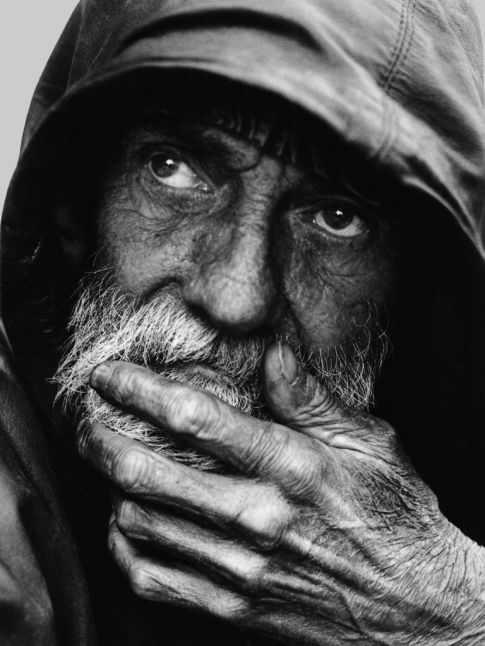
The real point here is that there is nothing, nothing in this life which is beyond the touch, the caress of God. There is no separation between the sacred and the profane. Certainly there is a separation between the sinful and the grace-filled, between love and fear, but there is no part of our lives or our world which does not relate to God. There is no part of our hearts that God does not long to inhabit, no part of our minds that He does not burn with desire for, the desire of a lover who waits. This false separation between the sacred and the profane came in with the loss of the sacramental mind, which is able to look at bread and wine and see Christ, to look at the marriage union and see Christ, to look at a simple pouring of water and see Christ. This is what allows us to look into the eyes of the poor and see not a nuisance or worthlessness, but Christ longing to be loved:


When the Church teaches that we are saved by the grace imparted through sacraments, she doesn't just mean that in a quantifiable sense (i.e., we need to receive so much grace through receiving the sacraments so many times in order to fill up our grace-bank). She also means that our hearts and our minds are formed by this very practice, formed in such a way as to allow us to participate in Christ's own life of self-gift, through our very bodies. Even when that body is sat down at a desk for 8 hours a day. Or spends dawn til dusk caring for children. Or lies in a hospital bed, dying. Nothing is beyond God's touch, and there is no part of the day when we cannot, with Paul, pray unceasingly.